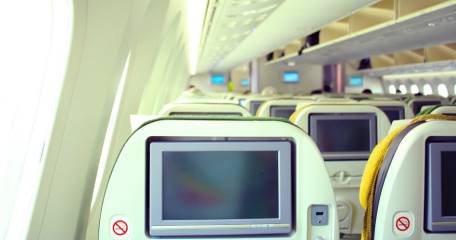
How safe is it to get on a plane?
The Truth About Cabin Air
Hundred-fifty passengers sitting on an air cabin together, barely half a metre distant away from each other: naturally people would be hesitant to board a plane during the current Covid-19 pandemic. Just a quick calculation: 150 people, sitting in an aeroplane for 2 hours, exhale what is the equivalent to 171 cubic meter when the cabin volume is of around 350 cubic meter.
The aviation industry has been one of the worst hit business sectors during pandemic. Airlines are therefore quashing passengers worries, re-assuring them that the risk of contracting the virus from other passengers in an airplane is very low. Cabin air quality is similar to that in an operating theatre. The air circulated in the cabin is passed through HEPA filters (High Efficiency Particulate Air filters), similar to those used to filter out air in hospital theatres.
Well, yes to a certain extent, but not exactly.
Air inside an aircraft is 50% fresh air and 50% recycled air. The engines provide the fresh air. Some of the air that could be used for thrust, is bled off, passed through air conditioning systems to cool it down and supplied to the cabin as fresh air. This creates demand on the engine so, by recirculating 50% of the air cabin demand, the airline saves money. However re-circulated air may contain fibres, dust, odours, skin scales, bacteria and viruses from passengers. This is why the re-circulated air is passed through a HEPA Filter. It is only the recycled air that is filtered through HEPA Filters.
HEPA filters come in different forms and sizes. Some are cylindrical, others are of the cassette type. Both types are used in aviation industry depending on the type of aircraft. Devine S. discusses the various issues affecting the properties and performance of Gel Seal HEPA filters: multiple reports of issues with HEPA filters from several vendors have been documented over the years. Many HEPA filter manufacturers test the integrity of the filters at the manufacturing site, however "Irrespectively of how rigorously the filters have been tested in the factories, these fragile items may suffer considerable damage in shipping or storage" (Devine S.).
Our company, Inspectra Ltd., is ISO17025 accredited in testing the air quality inside controlled environments such as hospital theatres. Installing a HEPA filter in the air circulation system does not automatically mean that all is fine. One of the tests that we perform on HEPA filters in hospital theatres is the "Installed Filter Leakage Test".
The test is performed by releasing a type of aerosol before the filter and using a spectrophotometer to detect any escape of the aerosol after the filter.
From our experience we have found out that, when installing new HEPA filters, 80% of the times, a leak is detected on the edge of the filter: it is not the filter itself that leaks, but it is the air that leaks out at the edge of the filter. The seal of the filter needs to be checked and verified to make sure that no air is escaping along the gasket and that all air flowing into the controlled environment is going through the filter.
Healthcare and the Pharmaceutical Industries are highly regulated, are governed by standards, and are audited regularly to check that these tests for air quality in controlled environments are performed regularly, with protocols in place.
The Aviation industry is of course also very highly regulated and air safety is the top priority.
IATA (International Airline Transport Association) states that filters are changed at regular 'Hard Time' intervals during routine maintenance intervals.
In order to make sure that the air cabin quality is as safe as it was designed to be for the health of all passengers on board, once changed, a filter leakage test should be performed.
References:
- IATA Corporate Communications January 2018
- Michaelis S, Lorraine T (2005) "Aircraft Cabin Air Filtration and Related Technologies: Requirements, Present Practice and Prospects", Hdb Env Chem Vol.4, Part H (2005): 261-x, Springer Verlag Berlin Heidelberg
- Devine, S. “Technical Bulletin: A Brief Discussion of Gel” 2012